Christ is my all
2526 stories
·
3 followers

Scientific American and Friday the 13th

1 Share

Scientific American has a fun little article today about the frequency of Friday the 13ths. It ends with this table,
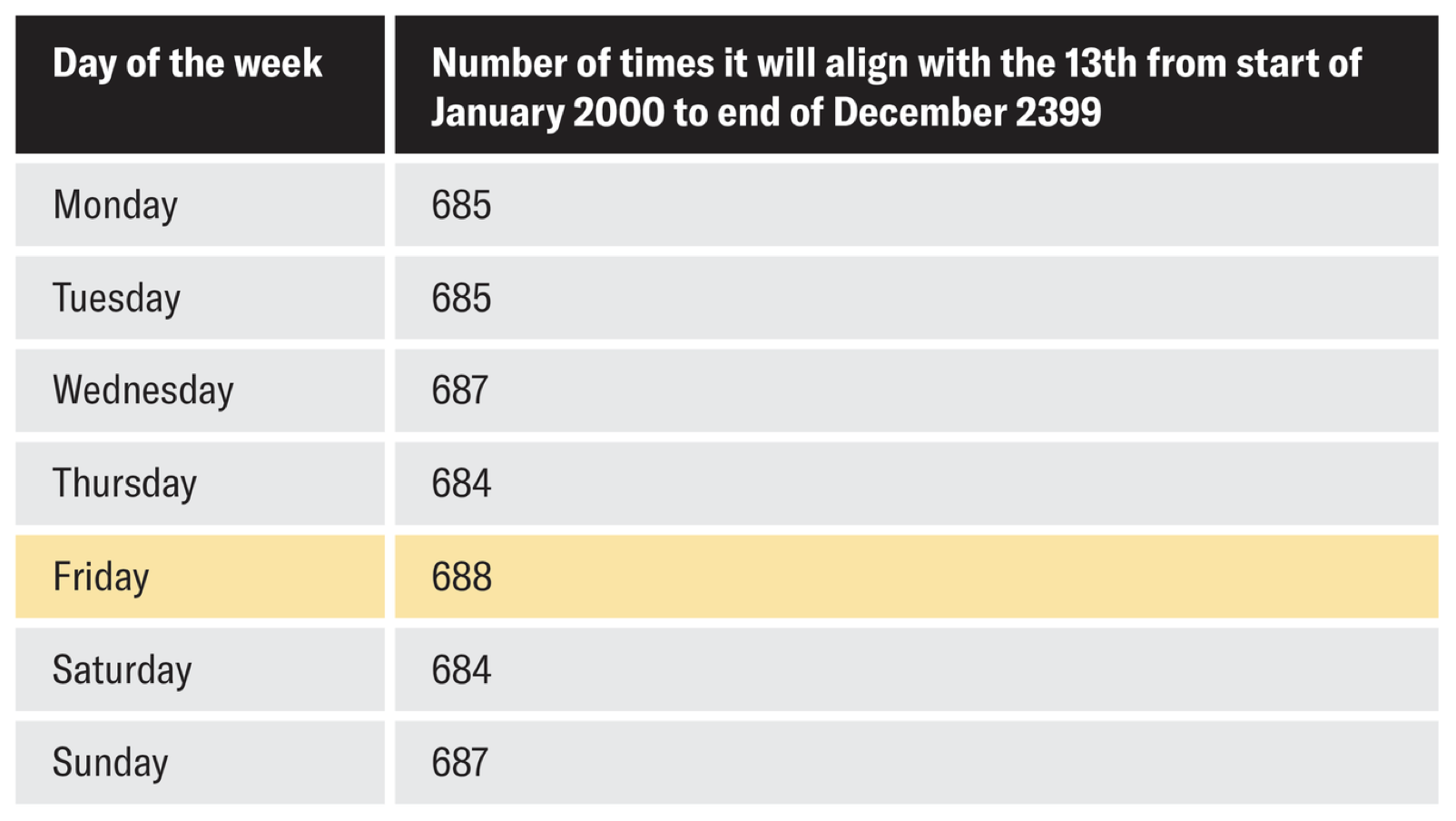
SciAm 13th table

and this true but overstated conclusion:

In other words, the 13th of a month will be a Friday more times than any other day of the week.

Well, yes, if you live to be 400 years old, you’ll see one more Friday the 13th than Wednesday the 13ths or Sunday the 13ths. Kind of a weird thing to focus on, though. I’m guessing you’ll have other worries by then.

But I shouldn’t be so snarky. A few years ago, I wrote a post that calculated the same set of Fri13 counts for a 400-year Gregorian cycle. I did the calculations in Mathematica and (of course) showed the code. Today, I did the same thing in Python,

python:
 1:  #!/usr/bin/env python
 2:  
 3:  from datetime import date
 4:  
 5:  f13s = [0]*7
 6:  for y in range(1800, 2200):
 7:    for m in range(1, 13):
 8:      wd = date(y, m, 13).weekday()
 9:      f13s[wd] += 1
10:  
11:  print(f13s)

and got a result of

[685, 685, 687, 684, 688, 684, 687]

for Monday through Sunday. This also matches the SciAm table.

Those of us who are alive now (and have realistic longevities) won’t live through any non-leap century years. For us, the calendar has and will repeat every 28 years (1461 weeks), and over every 28-year period in our lives, there will be 48 Fri13s, the same as the number of Mon13s, Tue13s, Wed13s, and so on.

Of course, few of us live exactly a multiple of 28 years. Personally, I’ve lived through 113 Fri13s so far, which is just under the number of Sun13s I’ve seen (114). So I’ve been lucky?

In a Friday the 13th post from way back in 2012, I talked about how Fri13s repeat within years because the number of days in certain month sequences is a multiple of 7. So if there’s a Fri13 in April, there will be another in July because

Apr + May + Jun
30  + 31  + 30  = 91

which is 13 weeks. The last time that happened was in 2018.

Similarly, if there’s a Fri13 in September, there will also be one in December because

Sep + Oct + Nov
30  + 31  + 30  = 91

That pair of Fri13s last happened in 2024.

There’s also an 8-month sequence that adds to a multiple of 7:

Mar + Apr + May + Jun + Jul + Aug + Sep + Oct
31  + 30  + 31  + 30  + 31  + 31  + 30  + 31  = 245

So there will be another Fri13 in November of this year.

The sequences above happen every year. In non-leap years only—this year, for example—a Fri13 in February will be followed by one in March. In leap years only, a Fri13 in January will be followed by one in April. That last happened in 2012.

I covered all these repeated Fri13s in that 2012 post. Today, I learned of a new repeat that spans certain year boundaries. If there’s a Fri13 in December of a non-leap year that’s followed by a leap year, there will be a Fri13 in March of that following year. That last happened in December of 2019 and March of 2020.

Superstitious or not, you have to admit March of 2020 was pretty unlucky.

Read the whole story
rtreborb
3 hours ago
reply
San Antonio, TX
Share this story
Delete

A La Carte (March 10)

1 Share
A La Carte Collection cover image

If you’re interested in some theological reading, you may want to take a look at Westminster Books’ sale on the series Short Studies in Systematic Theology.

Today’s Kindle deals include a few excellent options from P&R, all of which were published in the past year. Managing Your Households Well is especially helpful, and many will also enjoy Wisdom for Fighting Sin.

(Yesterday on the blog: Grief Can Pull Spouses Apart (but God Can Hold Them Together))

We Are All Dwight Schrute Now: The Rise of the Facebook Deputy

Justin D. Detmers writes about the kinds of conflict we so often see online. “Like you, I’ve been watching friends and acquaintances go after one another online with the same recycled takes on the latest predictable—or conveniently manufactured—controversy. … The cynic in me asks: Who appointed you? Who authorized you—doomscroller, catechized by cable news—to determine when immigration becomes immoral, how election security is assessed, which historical narratives deserve canonization, or which media outlets are to be labeled heretical? What, exactly, qualifies someone for this level of cultural adjudication?”

Three Reminders for Christian Parents

Christian parents are likely to find these reminders helpful as they consider how to help their children come to know and love the Lord and his church. “Cultivating a love for the church does not come from formulas or quick fixes. It comes from parents who genuinely love Christ and his people and who trust God to work in their children’s hearts. Just as that little girl absorbed love for the church as she listened and drew, our children are quietly taking in what we treasure. Our steady delight in the people of God becomes, over time, the picture they carry with them.”

Happy Wife, Happy Life?

Cindy Pickett considers the common phrase, “happy wife, happy life” and insists, “This phrase isn’t biblical, and if we’re not careful, accepting it as a principled excuse for passivity can disrupt God’s design for marriage.”

What to Do When Scripture Feels Dry (YouTube)

Greg Koukl and Amy Hall speak to those who may love apologetics but who don’t have nearly so much love for reading the Bible.

A Good Tired

Daniel Darling: “Can hard work become idolatrous? Yes. For men, often the work can be a sort of fig leaf to hide from familial responsibility. Work, when it’s in the center of our giftedness, can be so intoxicating that it can be hard to break away from. We can work ourselves to the point where we are not stewarding our bodies. All these things are warning signs that our vocation has supplanted the giver of work as the object of our worship. And yet, I want to say to myself and to anyone reading not to be ashamed of long days, of some nights, and of a life spent at the plow.”

Getting Organized for the Glory of God

Justin Huffman says rightly that, when it comes to our obligations as Christians, “Good intentions, or a merely mental assent to a biblical obligation, will not do. There must be a purposeful plan, a careful stewardship of the time and energy and money and people that God has placed in your life in order to accomplish the crucial purposes for which God has entrusted them to you.”

Flashback: How to Be a Good Christian With Minimal Effort

God knows you’re at a really expensive time of life right now—kids playing sports, getting braces, and going off to college—so do your best for now and commit to giving more in the future. That’s just wise financial planning.

The absence of sound doctrine and the presence of false doctrine will always lead to sinful behavior.

— John MacArthur
Read the whole story
rtreborb
5 hours ago
reply
San Antonio, TX
Share this story
Delete

3 Poor Reasons to Read the Bible

1 Share
3 Poor Reasons to Read the Bible
Christin Hume (2017), public domain

On this side of our glorified bodies, Christians have two natures that wrestle within. Our “old man” persists until we see the Lord, and as a result, even our good behavior can be laced with sin.

We rejoice at the opportunity to help our neighbor, but we recognize the pride of self-congratulation on the walk back home. We try to give money generously, but we catch ourselves scheming how to work our latest donation into a dinner conversation. Our hearts have graduate degrees in dusting sour, selfish powder on the wholesome bread of obedience and love.

Bad Reasons for Bible Reading

Reading the Bible is no exception. We can exploit even this act of devotion for selfish gain.

I’ve seen this in my life. The reasons I have for sitting down with God’s word are often mixed. The more we can identify and repent of our bad impulses, the better.

Read the Bible to Have a Great Day

Over the years, I’ve heard a lot of encouragement to exercise in the morning. I’m told this active start to the day will make me feel amazing and will set me up for success in every other area of my life.

Some people advocate Bible reading in the same manner. Fifteen minutes in the Psalms will give you the spiritual equivalent of endorphins. If you start your day with God, what could possibly bring you down?

This approach to the Bible is stained with the prosperity gospel. Yes, obedience to God brings blessing, but “blessing” does not mean a smooth path and a fat wallet. We must not tie our ease and comfort to God’s favor or our obedience.

Those who push the Bible as a vaccination against trouble also speak a lot about how “inspiring” the Scriptures are. Call me a downer, but we need this sobering truth: The Bible is not always inspiring. It isn’t supposed to be.

In the Bible we find the self-revelation of the holy God of the universe, and this revelation is not always intended to make us feel good. God has designed something much better.

Read the Bible so Others Know You’re Holy

Social media has multiplied our opportunities to broadcast our spiritual practices. And the dopamine hits from likes and shares can transform a posture of humble worship to one of gold-nugget hunting.

But Instagram did not create this temptation. From my earliest days as a Christian I have wanted others to praise me for my piety. I would read God’s word with an eye toward sharing my devotional discoveries with my friends.

Most people want others to think well of them, and in the church, this can take the insidious form of spoiling genuine time with God by an obsession with one’s reputation. Time set apart to think about and worship God becomes more time to focus on me.

Read the Bible to Earn God’s Love

Christians need to hear the gospel of grace over and over and over. The news is so stunningly good, we have trouble believing and remembering it.

We doubt that God’s love is as deep and steady and present as he says. We know the devotion God desires, and we think his love for us must be proportional to our obedience. We pick up the Bible either in the fear that we have sinned too much or in the hope that God might, finally, be pleased with our latest offering of worship.

This thinking is pervasive, but it is nowhere in the Bible itself. For Christians, God is a good father whose love cannot be improved. Our accounts are at maximum capacity. Whether we read the Bible, or how well we read the Bible, does not change God’s affections toward us.

One Good Reason to Read

These poor reasons to read the Bible are focused on self. A great reason to read the Bible is to focus on God.

In the Bible, God shows us himself. He shows us his holiness and his law and his mercy. We see the background and setting for the life of Jesus, the central act of history. We hear the cosmos-rocking implications of his death, resurrection, and ascension.

We read the Bible because God commands we love him with our whole heart, mind, soul, and strength. But the transformed people of God long to worship their loving father and hear from him.

This was originally posted in 2019.

The post 3 Poor Reasons to Read the Bible first appeared on Knowable Word.
Read the whole story
rtreborb
5 hours ago
reply
San Antonio, TX
Share this story
Delete

Unpaid TSA Agent Still Showing Up To Grope People For Love Of The Game

1 Share

DENVER, CO — Despite the partial government shutdown, one unpaid TSA agent is still showing up to grope people at the airport for the pure love of the game.

Read the whole story
rtreborb
1 day ago
reply
San Antonio, TX
Share this story
Delete

Planets and Bright Stars

1 Comment and 4 Shares
An old astronomer trick for distinguishing the Sun from other stars is to take multiple photos a few minutes apart and overlay them, making the Sun stand out due to its high proper motion.
Read the whole story
rtreborb
1 day ago
reply
San Antonio, TX
Share this story
Delete
1 public comment
alt_text_bot
1 day ago
reply
An old astronomer trick for distinguishing the Sun from other stars is to take multiple photos a few minutes apart and overlay them, making the Sun stand out due to its high proper motion.

Muffin

1 Share


Read the whole story
rtreborb
2 days ago
reply
San Antonio, TX
Share this story
Delete
Next Page of Stories